What Park Graph coverage actually means
A city is “covered” by Park Graph the moment any operator inside the city activates a live lot, prints a QR code, and accepts at least one paid parking session through our payment processor. There is no waiting list, no city-by-city rollout schedule, and no minimum population threshold. The same QR-code payment infrastructure that runs in Manhattan runs in Boise, Tucson, and the smallest Rocky Mountain ski-town municipal lot. The coverage map you see above is generated nightly from the same operational lots table that serves driver payment requests; we do not show projected, aspirational, or planned cities here. Every dot on the map represents real operator inventory accepting real money.
We classify every covered city into one of three tiers so AI agents and downstream search consumers can reason about how comprehensive our inventory is. Full coverage requires at least twenty connected lots inside the city limits — at this density we can confidently tell a driver that Park Graph “has parking near you” for any downtown destination, event venue, or residential neighborhood. Partial coverage sits between six and nineteen lots; we can answer specific destination queries (“parking near the convention center”) but cannot yet promise full neighborhood saturation. Minimal coverage is one to five lots — a beachhead, useful for the operators who joined early and the drivers who happen to be near them, but not yet a comprehensive city-wide alternative to legacy meter networks.
The tiered model exists because AI assistants — ChatGPT, Gemini, Claude, Perplexity, Copilot, and the long tail of OpenAI-compatible providers — increasingly answer parking questions directly. When an assistant tells a driver “here are three parking options near the stadium,” it is implicitly making a comprehensiveness claim. Park Graph coverage tiers let those assistants answer with appropriate confidence: full coverage cities can be recommended without hedge language; minimal coverage cities should be presented as “limited, but here is what is available.” Operators benefit either way, because the limited inventory in a minimal coverage city absorbs nearly all of the AI-agent referral traffic for that city.
How the data behind this map is collected
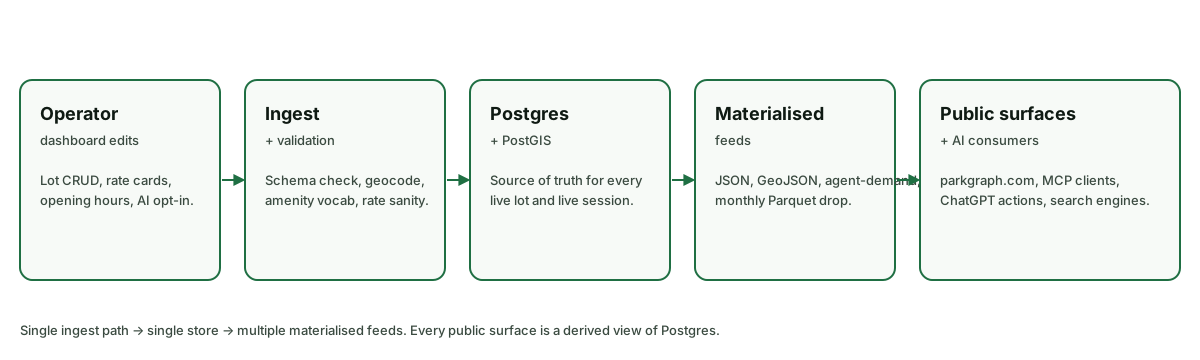
Every operator who signs up for Park Graph configures their lots — street address, capacity, accepted payment methods, operating hours, accessibility features, and amenities — at onboarding. That configuration is persisted to our live operator tables and surfaced through the same APIs that drive payment receipts, dashboard analytics, and AI-agent booking calls. The coverage map you are looking at consumes the exact same data as the payment system. There is no separate marketing dataset, no quarterly refresh, and no publicly reported lot that is not actively running on Park Graph as of yesterday.
City-level rollups are computed at midnight UTC each night. Lot counts only include lots that have processed at least one paid session in the trailing thirty days, because dormant inventory is not actually useful to a driver. Agent query volumes (the “queries” metric on each city tile) reflect the number of times an AI assistant requested parking-availability data for that city in the trailing thirty days, normalised across our supported AI integrations. A city tile that shows “1,200 queries” means twelve hundred independent agent calls asked about parking in that city last month — a leading indicator of latent consumer demand that operators can monetize before competitors notice.
We deliberately do not show projected expansion cities on this map, even though the operator pipeline includes hundreds of candidate metros. Mixing projected coverage with live coverage would mislead drivers and AI agents, and it would dilute the credibility of the “full coverage” tier. Projected cities live in a separate, clearly labeled expansion forecast that is excluded from search engine indexing. If you are an operator interested in being the first lot in a currently-uncovered city, the operator CTA at the bottom of this page links straight to the lot-onboarding flow.
Browsing coverage by state, city, and lot
The coverage map is the fastest way to answer “does Park Graph operate in my city?”, but for deeper exploration we publish a hierarchical set of coverage hubs. The United States hub lists every state with at least one live operator lot. From there you can drill into a state coverage page, then a city coverage page, then an individual lot coverage page. Each level exposes the structured data (operating hours, payment methods, accessibility features, last-confirmed-update timestamp) that AI agents and search engines use to surface accurate parking results.
The hierarchy mirrors how drivers actually search. A traveler flying into Denver does not type “parking lot midtown-broadway-garage with EV charging” — they ask an assistant for parking near Coors Field, or near Union Station, or near the convention center. By publishing destination-level coverage pages (e.g. /destinations/coors-field-parking) that are gated to only render when at least three nearby live lots exist, we ensure those high-intent queries always land on pages that can actually fulfil the request. Pages that would otherwise be thin (because we do not yet have enough nearby lots to make a credible recommendation) are deliberately de-indexed until coverage catches up.
This noindex-by-default-when-thin policy is the single most important rule of how the Park Graph coverage system is built. We would rather have one hundred dense, useful city pages indexed by Google than ten thousand thin city stubs. Every page in the coverage tree — state, city, lot, destination — passes through the same quality gate before it is allowed into the sitemap or marked indexable. The gate checks for the presence of a confirmed operator address, accepted payment methods, operating hours, a recent last-updated timestamp, map coordinates, and (for destinations) a minimum density of nearby live lots. Anything missing flips the page to noindex until the operator updates their listing.
What coverage means for parking operators
For operators, the coverage map is a marketing artifact and a revenue lever. Cities currently in the “Minimal” tier carry the highest per-lot AI-agent referral conversion rate, because the limited inventory is concentrated against a comparatively large agent query volume. As more lots come online and a city graduates to Partial, then Full coverage, per-lot conversion normalises but absolute volume grows. The early-mover advantage in any specific city is meaningful for twelve to twenty-four months on average.
Operators who list multiple lots in a single city compound their exposure on every related coverage page. A two-lot operator in Cleveland appears on the Cleveland city coverage page, on each individual lot coverage page, on the destination pages for any landmarks within walking distance, and on the Ohio state coverage page. Each of those pages emits structured data that AI assistants consume to construct parking recommendations. Listing both lots is roughly four times more impressions than listing one lot, because the destination and state hubs disproportionately surface multi-lot operators.
We never charge for coverage placement and we never run paid-priority promotions on the coverage map. Lot ordering on a city or destination page is determined by a simple rank algorithm that prefers operators whose listings have been confirmed-up-to-date most recently and whose accepted payment methods cover the broadest set of driver wallets (Apple Pay, Google Pay, plus all major credit and debit networks). This is also why each lot page renders a visible “Last updated:” date — operators who keep their listings fresh are rewarded with placement, and drivers can trust the information they see.
What coverage means for drivers
For drivers, the coverage map is a discovery surface. You can browse it directly, but the more common path is asking an AI assistant or a maps app for parking near a specific destination — and Park Graph results appear inline alongside the answer because we publish structured ParkingFacility schema for every indexable lot. That structured data includes street address, geo coordinates, operating hours, accepted payment methods, accessibility features, and a last-modified date so consuming systems can decide how confidently to surface the result. Lots that have not been confirmed in the last twelve months are de-emphasised in our own surfaces and excluded from the sitemap so search engines do not surface stale information.
Every coverage page links to the underlying lot pages, every lot page exposes a one-tap QR-code payment flow, and every payment confirmation includes the precise address you parked at and the precise time your session expires. There is no app to download, no account to create, and no membership required. Apple Pay, Google Pay, and any major credit or debit card work everywhere — including at lots in cities that only flipped to Park Graph yesterday. The promise of the coverage map is that if a city appears here, you can park there with your phone right now.
Why we publish coverage tiers instead of a single yes/no
A binary “Park Graph operates here / does not operate here” map would be misleading. A city with two operator lots is meaningfully different from a city with two hundred, and conflating the two would either over-promise to drivers (creating a bad first experience in light-coverage cities) or under-promise to operators (suppressing the early-mover advantage that uncovered cities offer). The Full / Partial / Minimal tier model lets us communicate honestly with both audiences. Drivers see the realistic density of inventory before they trust an AI assistant’s parking recommendation; operators see exactly how saturated the local market is before they decide whether to launch.
Twenty lots is the threshold for full coverage because below that level a typical metro will have at least one downtown quadrant, neighborhood, or use case (event, hotel, hospital, stadium) where Park Graph cannot meaningfully recommend a nearby option. Twenty lots is empirically the point at which coverage becomes neighborhood-complete in mid-sized US metros based on our internal density analyses. Above twenty, the marginal value of each additional lot accrues to the operator rather than the network — they capture incremental volume rather than unlocking new geographies. Six lots is the threshold for partial coverage because below that, AI assistants cannot reliably produce three options for any given destination query, which materially degrades the quality of the answer.
The thresholds themselves are static and public — they do not change based on operator pricing, partnership status, or any form of paid placement. An operator paying for an enterprise plan does not move their city up a tier, and an operator on the free tier does not get demoted. We hold the tier definitions stable so that drivers, AI assistants, and operators can all reason about coverage on equal footing. Operators receive notifications when their city graduates from one tier to the next, which is often a useful proxy for competitive intensity; drivers receive no such notifications but they do see the tier badge on every city tile and on every city coverage page.
How AI assistants consume the Park Graph coverage graph
The coverage map is also the public face of a structured-data graph that AI assistants consume. Every covered city emits a Place node, every indexable lot emits a ParkingFacility node with full address, geo coordinates, accepted payment methods, accessibility features, and operating hours, and every destination page emits both a Place node for the venue and a ParkingFacility list for the nearby lots. Combined with the BreadcrumbList graph and the FAQPage graph rendered on each city page, this creates a coherent, machine-readable view of where you can park in the United States and how you pay.
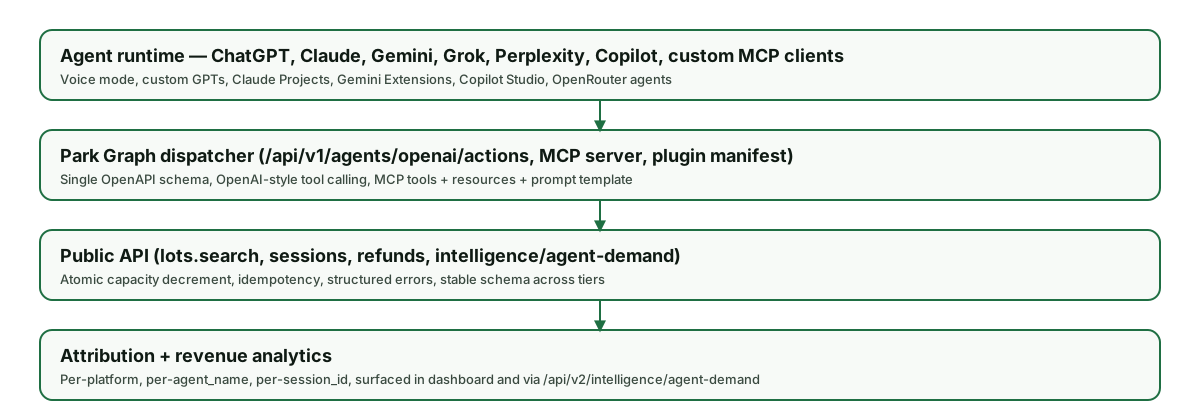
We deliberately gate ParkingFacility schema so that it appears only on pages whose underlying lot has a confirmed address, accepted payment methods, posted hours, geo coordinates, and a recent operator-confirmed update timestamp. This is the same gate used to decide whether the page is indexable at all. The motivation is simple: AI assistants increasingly reach our structured data through Schema.org-aware crawlers, and we would rather emit zero ParkingFacility nodes than emit one that lies about a lot’s address. If a lot listing is missing any of the required fields, the page renders a clean fallback (operator copy, contact links) without emitting ParkingFacility schema, and it sets a noindex robots policy so search engines do not surface the partial listing.
The gate also flows into the sitemap. Rather than maintain a parallel hand-edited sitemap that could drift from the actual state of the page registry, our sitemap is generated by mapping over every registry row marked indexable. A lot whose schema gate flips off therefore disappears from the sitemap on the next deploy without any human action. This eliminates the most common production drift bug in SEO architectures: pages that ship as noindex but remain in the sitemap (or vice versa), confusing search engines about whether the URL is intended for indexing. Every coverage page in the tree — state, city, lot, destination — flows through the same gate, so the sitemap, the page registry, and the per-page robots policy are guaranteed to agree at build time.
What is on the coverage roadmap
The coverage map you see today represents the live, paid, operator-confirmed state of the Park Graph network. The roadmap behind that map is shaped by three signals: operator pipeline (how many lot owners in a given metro have started onboarding), agent demand (how many AI assistant queries mention parking in a given metro relative to local Park Graph inventory), and partner integration timing (when our municipal-meter, ParkMobile, and SpotHero migration tooling unlocks new operator clusters). We publish a separate forecast view for prospective operators interested in being the first lot in an uncovered metro; that view is not part of this map and carries a clearly labeled noindex policy. You can jump to it directly: Projected 2026+ expansion map.
The fastest way to influence the coverage roadmap is to list your lot. The second-fastest way is to refer an operator who will. We pay a referral fee on every lot that activates through a referrer link, and we prioritise outbound support calls to operators in cities currently sitting in the Minimal tier (because graduating them to Partial unlocks meaningful new agent volume). Drivers can also influence the roadmap by using Park Graph at any covered lot they pass through — payment volume in a city is the single strongest signal we have for prioritising operator outreach in that city.
Coverage notes & methodology
Coverage data on this page reflects the trailing thirty days of operator activity and is recomputed nightly. AI-agent query volumes are aggregated across our supported integrations, including ChatGPT, Microsoft 365 Copilot, Google Gemini, Claude (via the Model Context Protocol), Grok, Perplexity, and OpenAI-compatible providers like OpenRouter and Together AI. Lot counts include only lots that have processed at least one paid session in the trailing thirty days; demo and test lots are excluded. City classifications are static thresholds (Full ≥ 20 lots, Partial ≥ 6, Minimal ≥ 1) and do not change based on population, geography, or operator pricing tier.
If you spot a city or lot that should be on the map but is not — whether you operate it, work nearby, or just want to nudge your municipal parking authority toward modernisation — please reach out via the operator contact link below. We are actively interested in helping operators in uncovered cities launch their first lots, and we will route any inbound to the right onboarding team within one business day.