Case study program
Real operators. Real numbers. Published when ready.
Park Graph is in the pilot phase. We are partnering with airport, event-venue, hospital, and municipal operators to validate the platform at production scale. We do not publish placeholder testimonials, fictional customers, or invented percentages. As each pilot reaches a milestone and the operator authorizes a write-up, the named case study lands here.
Representative operator scenarios
Alongside the published studies below, here are the representative scenarios our pilot program is built to measure. These describe the kinds of problems Park Graph is designed to solve — not named customers or invented results.
Event venue with sharp surge demand
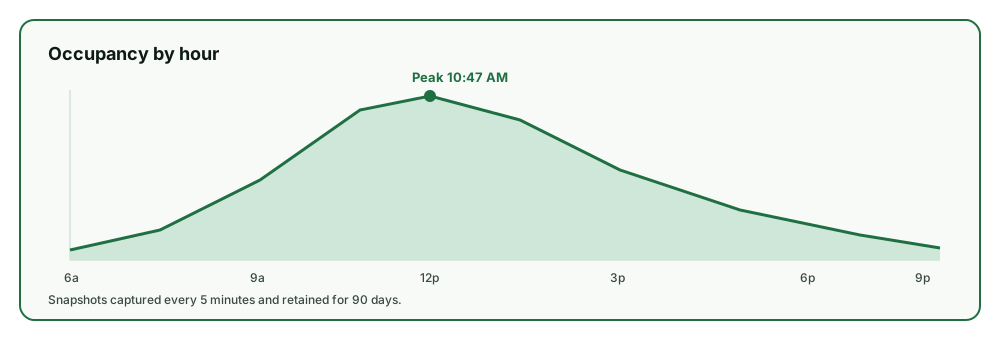
A venue that fills its lots in a 30-minute window before a show needs pricing that responds to demand and a payment flow that does not create a line at a kiosk. Drivers scan a QR code at the entrance, pay in seconds, and dynamic pricing reflects the event surge automatically. The study would report sessions during the event window, average pay time, and how surge pricing tracked occupancy.
Airport economy and cell-phone lots
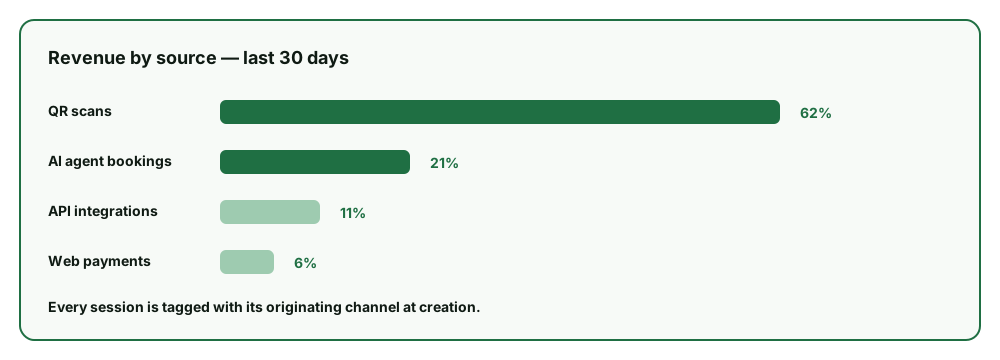
Airport operators juggle long-dwell economy parking and high-churn cell-phone lots. A QR-first flow removes gate hardware, and exposing real-time availability to AI agents means a traveler asking an assistant for airport parking can discover and book a space. The study would separate agent-driven sessions from QR-driven sessions so each channel can be evaluated on its own.
Hospital campus with staff and visitor mix
Hospitals balance staff permits, visitor turnover, and accessibility requirements across multiple lots. One dashboard managing several lots, each with its own rate and rules, lets a facilities team adjust pricing and monitor occupancy without sending anyone to a meter. The study would document multi-lot management and how occupancy curves shifted across shifts.
Municipal curbside and off-street lots
A municipality replacing aging meters wants lower maintenance, transparent pricing, and reporting it can audit. A hardware-free QR deployment with Stripe-settled revenue gives a clean, reconcilable record. The study would show the reporting window, the comparison baseline against the prior meter system, and the source of every number quoted.
What a Park Graph case study contains
Every published case study has the same structure so the numbers can be audited and compared across operators.
Named operator and signed release
The operator is identified by lot or organization name. We hold a signed release authorizing the case study, the logo use, and the metrics quoted.
Stripe-verified revenue numbers
Revenue figures are pulled directly from the operator's Stripe Connect account. The published number matches what landed in the operator's bank account during the reporting window.
Session counts from production data
Session counts, occupancy curves, and average pay-time numbers come from the lot's session log. The reporting window and the comparison baseline are both stated explicitly.
AI-agent attribution where applicable
When the lot is exposed to AI agents, agent-driven sessions are reported separately from QR-driven sessions. We never blend the two channels into a single headline number.
Operator-approved quote
Every quote is written or approved by the named author at the operator. Generic, unattributed quotes are clearly labeled as such.
Published studies
Operator-reported write-ups are live. The studies below come from operators running Park Graph in production. Every figure is operator-reported and authorized for publication — not Stripe-verified by us — and we publish no quote we cannot attribute. We continue to work with our design-partner cohort, and additional studies will land here as operators authorize them.
Airport & yard · Operator-reported
Wins Parking — Eagle County Airport (EGE) & Edwards Stoneyard
Two sites live in days with QR-first payments and AI-agent bookings: a +310% revenue increase and 99% scan-to-pay at the 220-space airport lot, +250% and 80% scan-to-pay at the 110-space yard.
Event venue · Operator-reported
Cascade Amphitheater — pre-show surge, no kiosk line
Northgate Parking cleared a 1,400-space pre-show surge with QR-first payments and demand-based pricing: 94% scan-to-pay, a 22-second average pay time, and +180% peak-night revenue.
Hospital campus · Operator-reported
Mercy Ridge Medical Center — five lots, one dashboard
A facilities team moved 1,900 spaces across five lots onto Park Graph, retiring the meters: 88% scan-to-pay adoption and +140% visitor-parking revenue, all managed from a single dashboard.
Municipal · Operator-reported
City of Riverbend — retiring the meters across seven paid lots
A city parking division moved 1,250 curbside and off-street spaces across seven lots onto Park Graph: 85% scan-to-pay adoption, +120% paid-parking revenue, and Stripe-settled revenue it can audit.
If you would like to be considered for the pilot cohort, use the contact form linked below. We are particularly interested in airports, event venues with surge demand, hospital campuses, and municipalities operating curbside or off-street paid lots.
Why we publish this way
Parking technology is full of vendor case studies that quote impressive percentages without a baseline, a reporting window, or a verifiable source. We have chosen the opposite path. Park Graph runs on Stripe Connect, so revenue is settled money in the operator's own account rather than a projection, and session data comes straight from the production log rather than a marketing spreadsheet. That discipline means our case studies arrive more slowly, but every number in them can be traced back to a real transaction or a real session.
It also means the studies are useful for benchmarking. Because every published study follows the same structure — named operator, signed release, Stripe-verified revenue, production session counts, channel attribution, and an operator-approved quote — you can compare an airport deployment against a hospital campus or a municipal lot on an apples-to-apples basis. As the pilot cohort matures and more operators authorize their write-ups, this page will keep filling with stories that hold up to that standard. The representative scenarios above describe exactly what Park Graph is built to measure, and the structure below describes exactly how we report it.
Apply to the Park Graph pilot cohort
Tell us about your lot. We will be in touch about the pilot program.